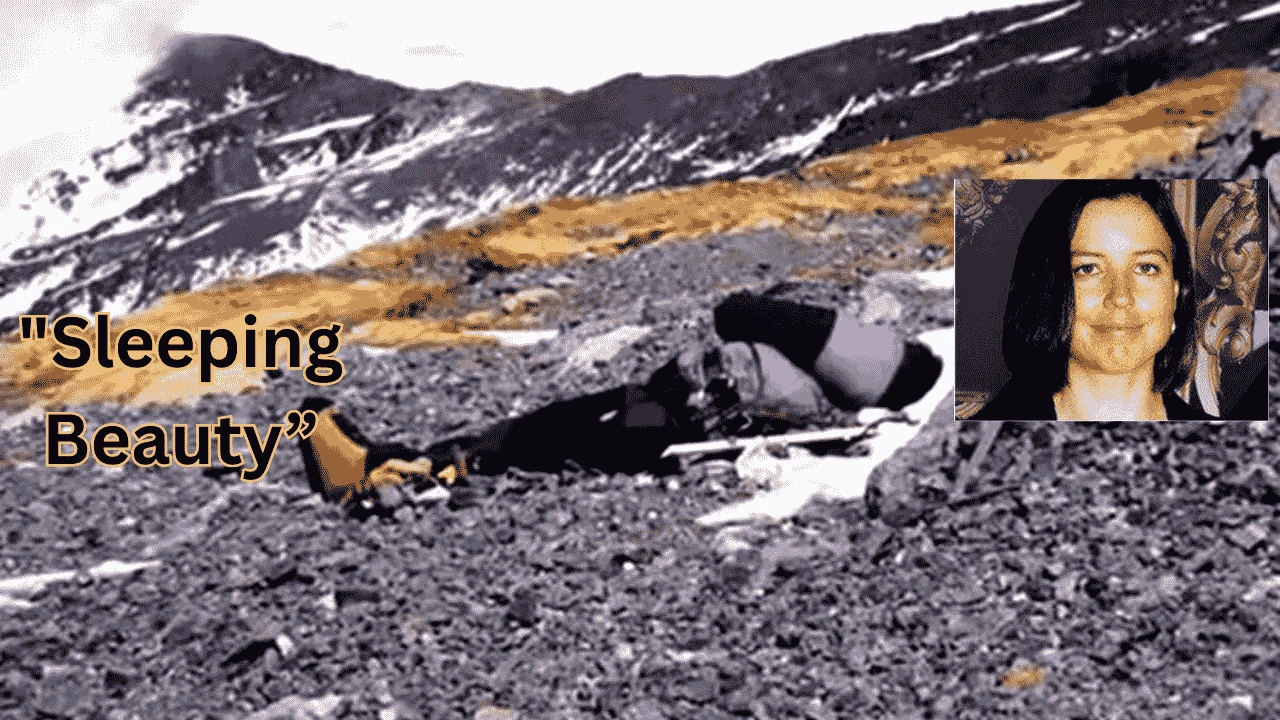
Everest’s history is filled with tragic stories, but few are as haunting as that of American climber Francys Arsentiev. For years, her body remained visible along the mountain’s climbing route, resting in a position so peaceful it looked as though she were simply asleep — earning her the nickname “The Sleeping Beauty of Everest.” This is the story of her life, her final climb, and the tragic end that made her one of the most talked-about figures in Everest’s history.
Who Was Francys Arsentiev?
Francys Arsentiev was born in Honolulu, Hawaii. From an early age, she had a deep love for nature and outdoor adventure. After completing her education, she worked in finance, but her fascination with mountains eventually pulled her toward climbing. After marrying Sergei Arsentiev, an experienced Russian mountaineer, her passion for high-altitude climbing grew even stronger, and the couple went on to climb several major peaks together.
The Dream of Everest
In 1998, Francys set an ambitious goal: to climb Everest via the North Ridge route without the use of supplemental oxygen. If successful, she would become the first American woman ever to summit Everest without bottled oxygen. She and Sergei spent weeks acclimatizing at the higher camps before finally beginning their summit push.
After a long and exhausting climb, Francys reached the top and achieved her dream. But on Everest, reaching the summit is only half the battle — the descent is often where things go wrong, and it was on the way down that her luck ran out.
Trapped in the Death Zone
During the descent, Francys and Sergei became separated. Without supplemental oxygen and after spending far too long in the Death Zone — the region above 8,000 meters where the human body cannot function normally — her body and mind began to fail her. Severe hypoxia left her extremely weak, and she lost the ability to continue descending on her own. Other climbers later found her lying at the side of the route, barely conscious and suffering from extreme cold.
Around the same time, Sergei climbed back up in a desperate attempt to reach his wife. He was never seen again. In the end, both husband and wife — bound together by extraordinary courage and love — were lost to the mountain.
Why “Sleeping Beauty”?
For nearly a decade after her death, Francys’s body remained visible along Everest’s main climbing route. She lay in a calm, almost restful position, still clipped to the fixed ropes. It was this peaceful, undisturbed appearance that led later climbers to give her the nickname “Sleeping Beauty” — a name that sounds gentle, but actually carries the weight of one of the mountain’s most sorrowful stories.
Her death also raised a difficult ethical question that still echoes through the climbing community: when someone is dying in the Death Zone, what can other climbers realistically do? Many who encountered her later said they themselves were operating at the very edge of survival and simply lacked the physical strength to carry her down. Her story remains one of the clearest illustrations of just how difficult — often impossible — rescue becomes at extreme altitude.
Legacy and Remembrance
The story of Francys Arsentiev has left a lasting impression on climbers around the world. It’s a story that blends courage, ambition, love, and the unforgiving power of nature. Years later, it’s reported that some expeditions respectfully moved her body away from the main route, out of view of passing climbers. But her story continues to live on in Everest’s history.
Even today, when experienced guides talk to new climbers about the dangers of the Death Zone, Francys Arsentiev’s name often comes up — a living, if tragic, reminder of just how delicate the balance is between ambition and caution at the top of the world.